


Welcome to The Median, DataCamp’s newsletter for March 6, 2026.
In this edition: Anthropic’s legal challenge against the Pentagon, China’s new five-year AI plan, the launch of OpenAI’s GPT-5.4, Google’s introduction of Gemini 3.1 Flash-Lite, and Anthropic’s new report on AI’s impact on the labor market.
This Week in 60 Seconds
Anthropic to Challenge Pentagon Supply-Chain Risk Designation in Court
The Pentagon has officially designated Anthropic as a supply-chain risk following a dispute over the military’s use of the company’s AI models. Anthropic plans to challenge the ruling in court. CEO Dario Amodei noted that while the restriction affects direct contracts with the Department of War, it will only impact a small fraction of their overall revenue and leaves broader enterprise relationships intact. At the same time, OpenAI agreed to a partnership with the defense department, which prompted a negative response from its users. Following the announcement, ChatGPT saw a 295% day-over-day spike in U.S. app uninstalls and a 775% surge in one-star reviews, while Anthropic’s Claude experienced a significant increase in downloads.
China Releases Five-Year Plan Focused on AI Integration and Emerging Tech
China has released a new five-year policy blueprint outlining its goal to aggressively adopt artificial intelligence across its economy and secure dominance in frontier technologies. The document introduces a comprehensive “AI+ action plan” designed to counter the country’s demographic crisis and compete directly with the United States in core tech sectors. Specific initiatives include deploying robots and AI agents to offset labor shortages in manufacturing, logistics, and healthcare to boost overall productivity. The government also pledged to increase investment in basic research, quantum computing, and embodied AI while building hyper-scale computing clusters supported by abundant electricity.
OpenAI Launches GPT-5.4 in ChatGPT
OpenAI has officially released GPT-5.4 and its high-performance counterpart, GPT-5.4 Pro, making them available starting today across ChatGPT, the API, and Codex. Positioned as the company’s most capable model for complex, professional tasks, GPT-5.4 integrates advanced reasoning, coding, and autonomous agent workflows into a single system. A standout feature for everyday users is the new upfront thinking process in ChatGPT, which allows individuals to see the model’s plan and adjust its course mid-response to ensure better alignment with their goals. GPT-5.4 also marks OpenAI’s first general-purpose model equipped with native computer-use capabilities, enabling it to navigate desktop environments, browse the web, and operate software applications on its own. We’ve tested GPT-5.4 and reported the results in this blog.
Google Introduces Gemini 3.1 Flash-Lite for Developers
Google has introduced Gemini 3.1 Flash-Lite, marking it as the fastest and most cost-efficient model in its Gemini 3 lineup. The model is already available in preview for developers and enterprises through Google AI Studio and Vertex AI. The new model offers a 2.5 times faster response initiation and a 45% increase in output speed compared to the previous 2.5 Flash version. Despite its lower cost, it maintains high performance on complex reasoning and multimodal understanding benchmarks. The model also includes adjustable thinking levels, allowing developers to control how much processing time the AI dedicates to specific prompts. Developers can use Gemini 3.1 Flash-Lite for scaling operations like high-volume translation, content moderation, and responsive user interface generation.
Anthropic Report Examines AI’s Impact On The Labor Market
The impact of artificial intelligence is coming into clearer focus following a new report released by Anthropic about AI’s effect on the labor market. The research introduces a metric called “observed exposure” to highlight the substantial gap between what language models can theoretically accomplish and their actual, real-world adoption. Despite the growing integration of these tools, the data indicates there has been no systematic increase in unemployment for workers in highly exposed roles since late 2022. The study did identify friction at the entry level, noting a drop in the job-finding rate for young professionals aged 22 to 25 entering exposed fields. We explore the implications of this study in our Deeper Look section below.
Start Learning AI With the AI Fundamentals Track

A Deeper Look at This Week’s News: Sizing Up AI’s True Impact on the Labor Market
The conversation around AI replacing human jobs often relies on what language models can theoretically accomplish. A new report from Anthropic shifts the focus to what is actually happening in the labor market by measuring real-world usage.
Theoretical impact vs. observed exposure
In the past, researchers measured vulnerability by asking if an AI could theoretically perform a specific task. To provide a more grounded perspective, Anthropic introduced a new metric called “observed exposure.”
This measure shifts the focus from what is possible to what is actually happening and calculates whether a task is actively being automated in real, professional settings right now.
To determine a job’s observed exposure, researchers analyzed data from the Anthropic Economic Index. A profession scores higher on this metric if its core duties frequently appear in work-related AI usage, especially within fully automated workflows, and if those specific AI-assisted tasks make up a large portion of the worker’s day.
Applying this metric shows a gap between theory and reality. For example, researchers calculate that large language models could theoretically handle 94% of tasks within Computer and Math occupations. However, current real-world usage covers only about 33% of those tasks.
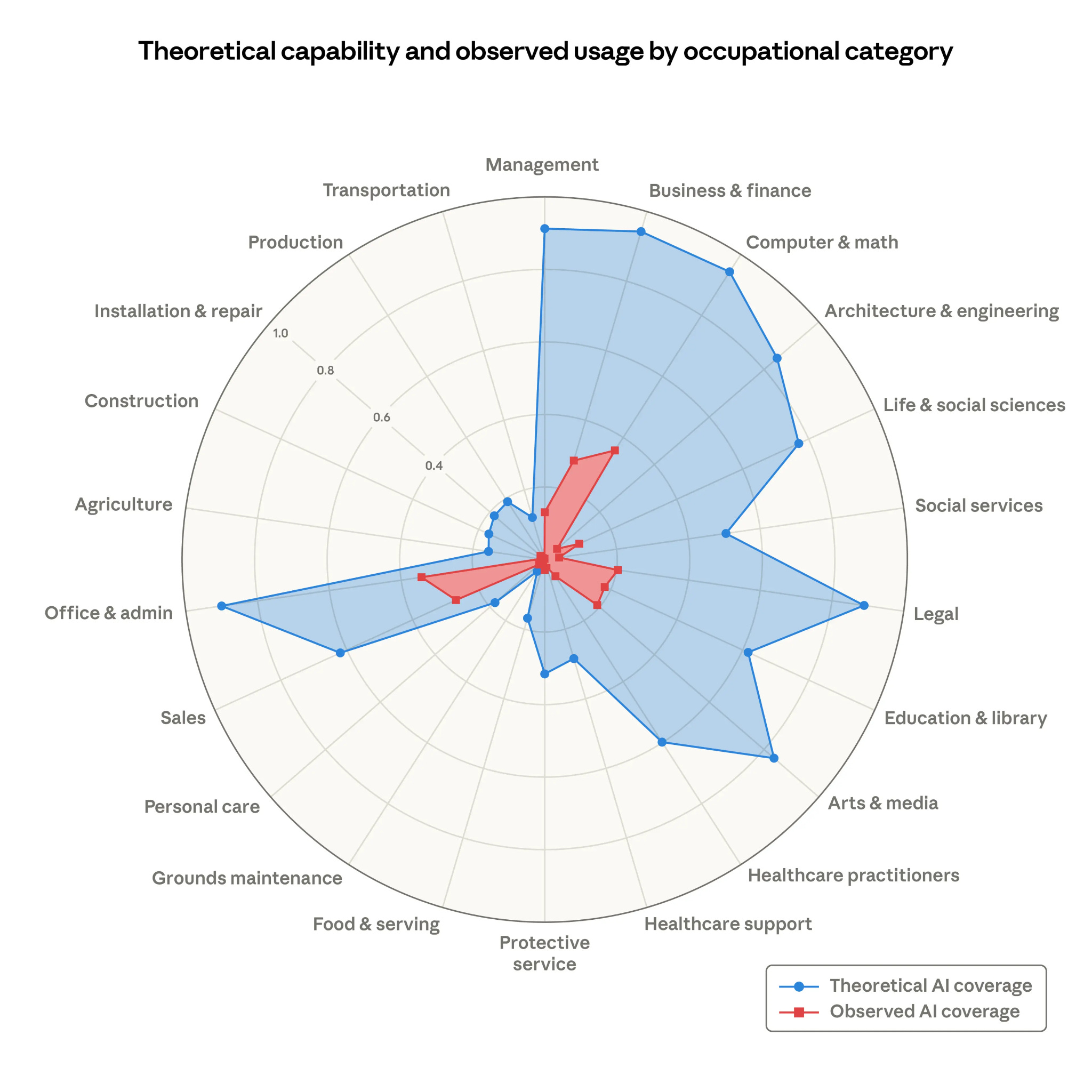
Source: Labor market impacts of AI (Anthropic)
At the other end of the spectrum, 30% of workers remain completely unexposed, as their daily tasks do not intersect with current AI capabilities and appear too infrequently in the usage data to meet the minimum threshold. This group includes roles such as motorcycle mechanics, dressing room attendants, cooks, bartenders, lifeguards, and dishwashers.
The most “at-risk” jobs are defying unemployment expectations
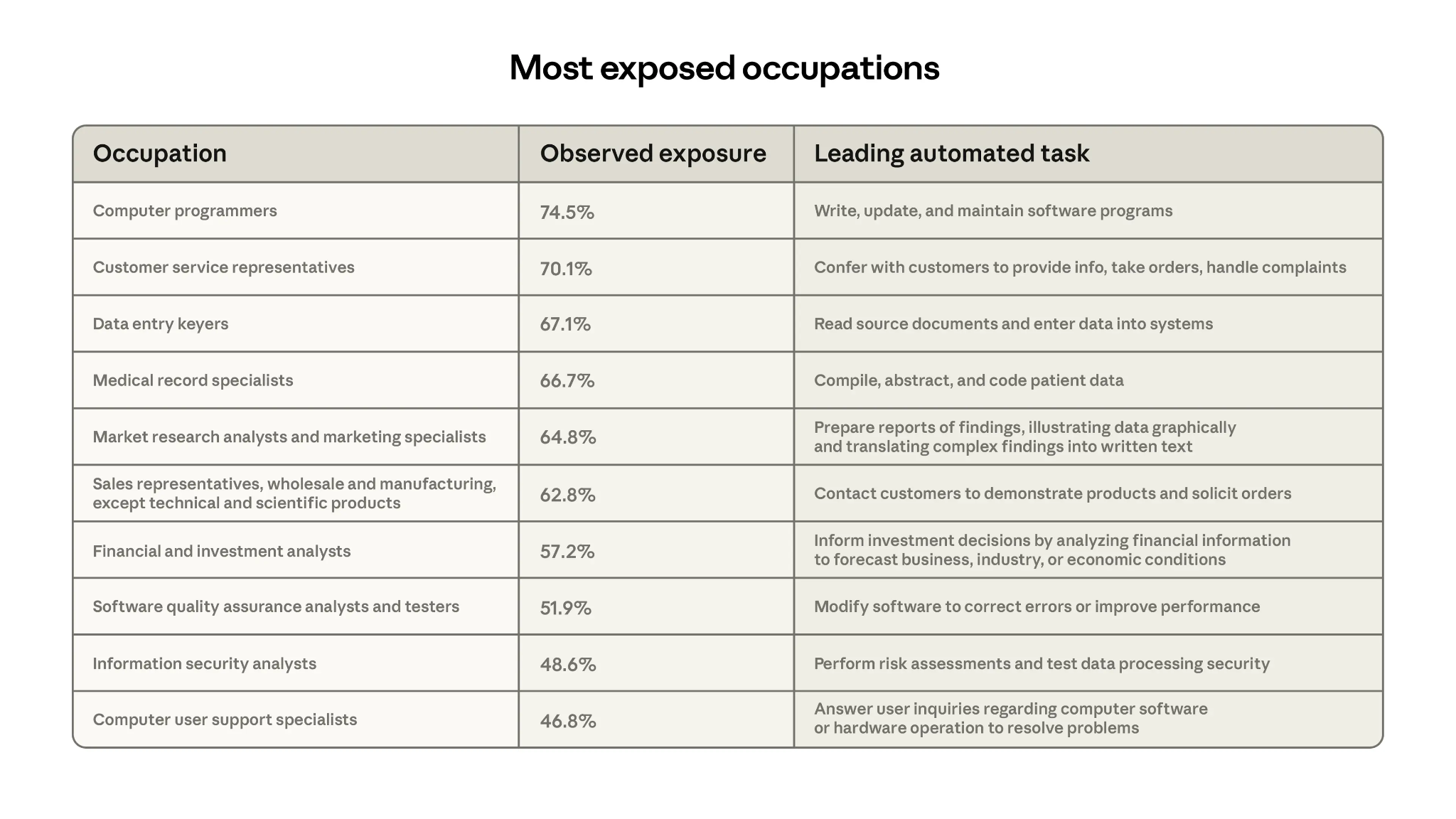
The report identifies specific roles experiencing the highest actual AI integration. Computer programmers sit at the top of the list with 74.5% observed exposure. Customer service representatives follow closely at 70.1%, and data entry keyers rank third with 67.1%.
Source: Labor market impacts of AI (Anthropic)
Note: This might seem confusing given that we’ve previously seen that the broader “Computer & Math” sector is only 33% covered by AI overall. The difference comes down to specific daily tasks: while a broad category includes hardware technicians doing physical work, a programmer’s core duties (writing and testing code) are highly suited to current language models and show up heavily in real-world usage.
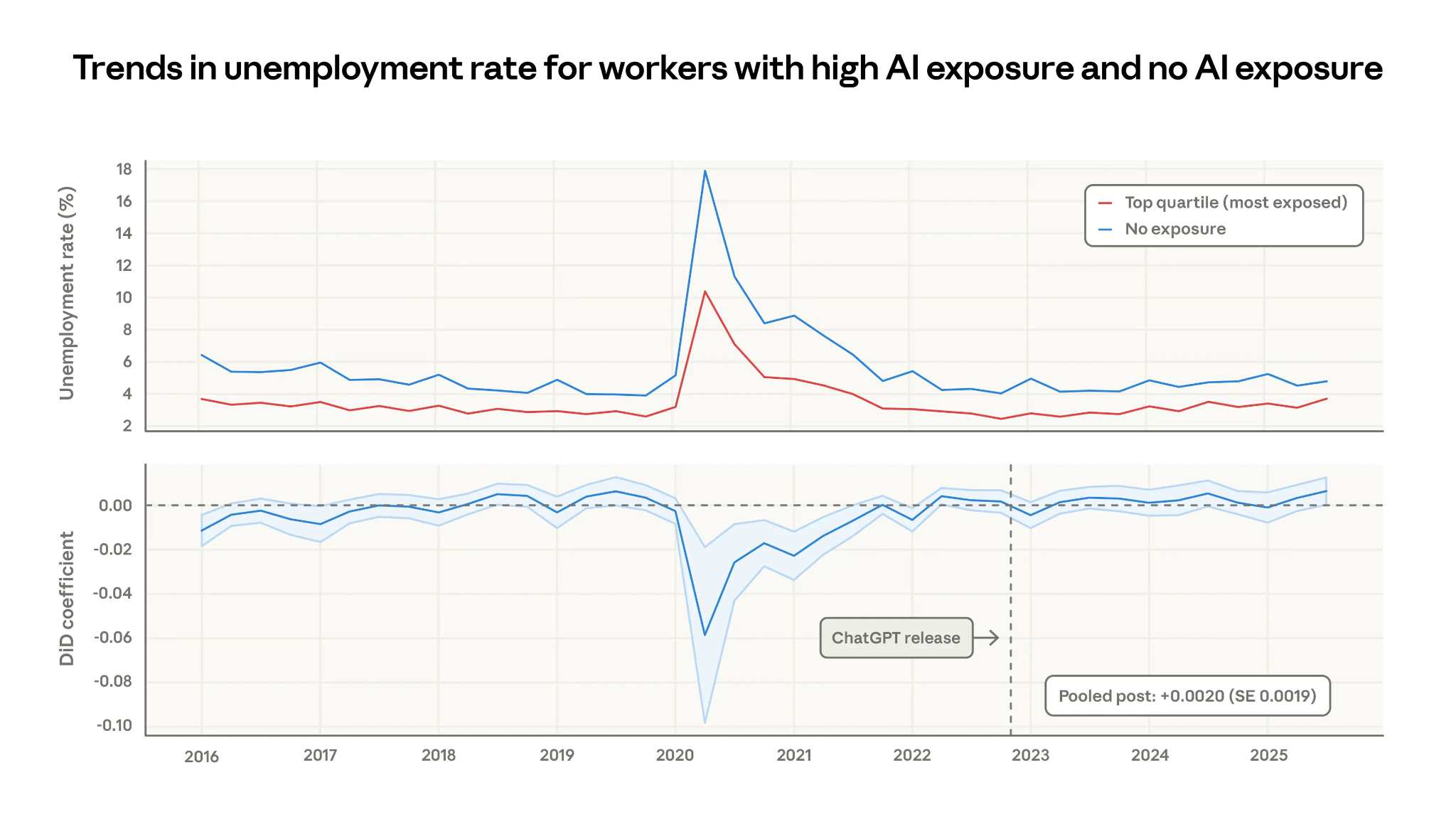
Despite the high exposure in specific knowledge-work fields, the expected wave of job losses is not visible in the macroeconomic data. Anthropic tracked unemployment rates using the Current Population Survey, focusing specifically on the period since the public release of ChatGPT in late 2022.
The researchers found no systematic increase in unemployment for the most highly exposed workers. When comparing individuals in the top quartile of observed exposure to those with zero exposure, the gap in unemployment rates has remained mostly flat. Any slight increase in unemployment for the highly exposed group is small and statistically indistinguishable from zero.
Source: Labor market impacts of AI (Anthropic)
According to the Anthropic researchers, if AI were causing an economic shock comparable to the 2007-2009 Great Recession, the data would show the unemployment rate for this top quartile doubling from 3% to 6%. Because this spike is entirely absent from the survey data, it appears that the current adoption of AI tools has not translated into widespread job displacement for existing employees.
The pressure on young workers
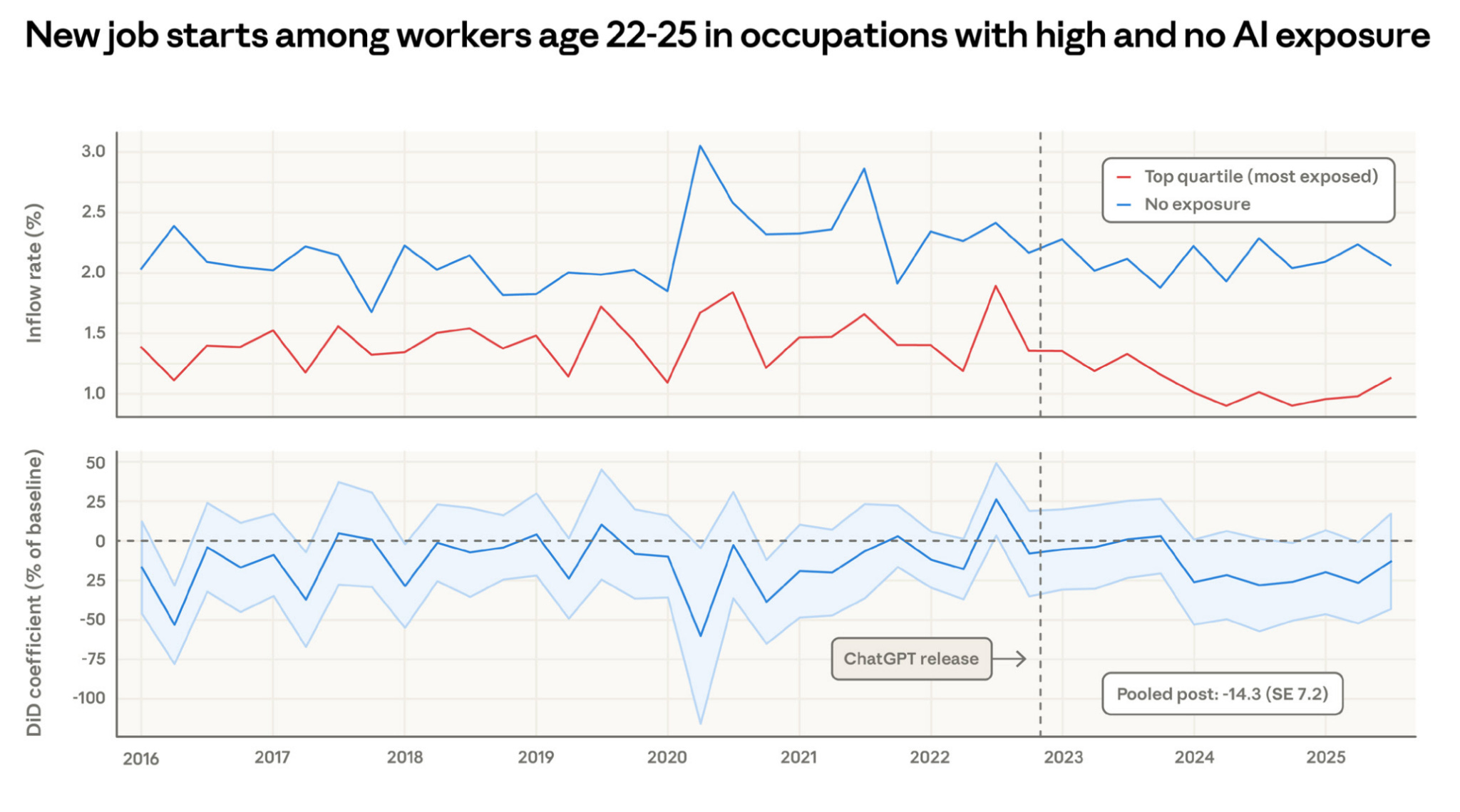
While mass layoffs are absent, there are some signs of friction at the entry level. The data points to a noticeable slowdown in hiring for young professionals, specifically those between the ages of 22 and 25, who are attempting to enter highly exposed occupations.
Source: Labor market impacts of AI (Anthropic)
It remains unclear from the current data whether these young professionals are losing entry-level opportunities to AI efficiencies, choosing to stay in their existing roles longer, finding work in different sectors, or opting to return to school. Regardless of the exact cause, this hiring slowdown marks the most visible labor market shift currently linked to AI adoption.
Industry Use Cases
Stanford Researchers Use AI to Map Parasitic Disease Risks
Researchers from Stanford University have developed a machine learning platform that integrates fieldwork data, drone photography, and satellite imagery to track schistosomiasis, a parasitic disease affecting 250 million people worldwide. The team built convolutional neural networks capable of identifying medically relevant freshwater snails and specific vegetation patterns associated with infection hotspots. By correlating high-resolution drone images with broader satellite data, the system allows public health officials to monitor transmission rates across large regions and prioritize outreach for at-risk populations. Read more in this article from Stanford HAI.
NVIDIA Introduces Open-Source Telco AI Models and Blueprints for Autonomous Networks
NVIDIA has introduced a 30-billion-parameter large telco model and a series of agentic AI blueprints designed to help telecommunications operators build autonomous networks. Developed in collaboration with AdaptKey AI and released as an open-source resource through the GSMA, the Nemotron-based model is trained on industry-specific data to reason through complex workflows like fault isolation and remediation planning. The company also rolled out new blueprints for energy efficiency and network configuration, which automate traffic regulation and reduce power consumption in 5G radio access networks. Read more in this article from NVIDIA.
Researchers Use GPT-5.2 Pro to Advance Quantum Gravity Mathematics
Researchers from institutions including the Institute for Advanced Study, Harvard, and OpenAI have published a new preprint demonstrating how GPT-5.2 Pro assisted in discovering a mathematical result in theoretical physics. Building on earlier work with other fundamental particles, the team used the AI model to calculate complex interactions between gravitons (the theoretical quantum bits of gravity). The AI model solved the problem using an unexpected mathematical technique and generated a preliminary draft of the paper, shifting the researchers’ primary focus from initial manual calculation to verification. Read more in this article from OpenAI.
Tokens of Wisdom
There’s a brand new wave of attacks coming, and the Internet will become a more dangerous place before it gets back to a safer place again.
—Jeremy Epling, CPO at Vanta
This week on the DataFramed podcast, we spoke with Jeremy Epling about AI-driven security risks, vendor data use, trade-secret leakage, and more.