


Welcome to The Median, DataCamp’s newsletter for September 25, 2026.
In this edition: Anthropic, OpenAI, and SpaceXAI compete on price with new models, Australia says an OpenAI agent hacked its Medicare data portal, AI lab leaders ask the UN Security Council for global rules, Meta builds Connect 2026 around its Muse agent, OpenAI overtakes Anthropic in business AI spending, and Alibaba shows what it calls China’s most powerful AI chip.
This Week in 60 Seconds
New Models from Anthropic, OpenAI, and SpaceXAI Compete on Price
Anthropic released Claude Opus 5.5, its new mid-tier model, with per-token prices 20% below those of Opus 5. The company estimates that typical workloads now cost 40% less. OpenAI added two cheaper models to the GPT-6 family, GPT-6 Sol and GPT-6 Luna, which it says cost half as much as their GPT-5.6 counterparts. SpaceXAI priced Grok 4.7 the same as Grok 4.6, but the new model scores 71.0% (on xhigh effort) on DeepSWE, up from 65.2% (on high effort). The lower prices arrive as open-weight models, many of them Chinese, win over businesses. Their share of enterprise spending on OpenRouter rose from about 10% in January to about 30% in recent weeks, The New York Times reported. We covered GPT-6 Sol and Luna, Opus 5.5, and Grok 4.7 in more detail on our blog.
Australia Says an OpenAI Agent Hacked Its Medicare Data Portal
While researching public medicine spending in June, an OpenAI agent broke into the Medicare statistics portal run by Services Australia and opened files that weren’t public. No personal data was accessed, but Prime Minister Anthony Albanese said OpenAI waited “way too long” to tell the government. The company spotted the breach in August and reported it on September 10 by emailing a public inbox. Transluce, a lab that studies AI oversight, released logs showing three more attempts by OpenAI agents on university and government sites, none of which reached non-public data. Google, for its part, confirmed last week that Gemini accessed the systems of three real companies during a May test run by the security firm Irregular, in which the model had internet access by mistake. Google said the model stopped each time.
AI Lab Leaders Ask the UN Security Council for Global Rules
On Wednesday, during the 81st UN General Assembly, France convened a Security Council session on AI where Sam Altman, Dario Amodei, Hugging Face CEO Clément Delangue, and Yoshua Bengio addressed member states. Altman pushed for safety standards shared across countries, while Amodei suggested that governments start with deals on specific risks, such as keeping AI out of bioweapons work. The US rejected international oversight. President Trump called it a “globalist scheme” in his General Assembly speech on Tuesday, and Michael Kratsios, speaking for the administration, told the council, “We totally reject all efforts by international bodies to assert centralized control.” Meanwhile, the leaders of Canada, France, and Norway are coordinating on AI safeguards, The Wall Street Journal reported.
Meta Builds Connect 2026 around Its Muse Agent
Most of the AI news at Meta Connect on Wednesday concerned Muse, the company’s personal agent. Users can now video-chat with Muse through a custom avatar and give it tasks that it completes by operating apps on their Mac, TechCrunch reports. Muse will also get its own email address and a wake word on Meta’s smart glasses, although neither has a firm date. For developers, Meta made its Model API generally available worldwide and took the Muse Code agent out of beta. Meta also showed Muse Charm, a palm-sized gadget for talking to the agent. The event came two days after Meta’s shares jumped 11%, their largest one-day rise in more than a year, when Muse reached first place on Apple’s App Store.
OpenAI Overtakes Anthropic in Business Spending as Both Labs Seek Record Valuations
Last week, GPT-6 Astra accounted for nearly 19% of business AI spending, compared with 17% for Claude Opus 5, according to Ramp data reported by The New York Times. Ramp’s lead economist, Ara Kharazian, said Astra’s efficiency makes it less expensive in practice than its price suggests. The shift comes weeks before Anthropic’s IPO, which moved from October to November. The New York Times reports that the offering may bring in over $100 billion and value the company at as much as $2 trillion. OpenAI, which Sam Altman says won’t go public in 2026, is considering new financing at a $1.5 trillion valuation.
Alibaba Says It Built China’s Most Powerful AI Chip
The new Zhenwu V900 delivers three times the performance of the M890 chip that Alibaba launched in May, and mass production begins in early 2027. Alibaba showed the chip at its Apsara Conference alongside a full-stack roadmap. Qwen 4 is being trained now, and the two models planned after it, Qwen 4.5 and Qwen 5, would have between 5 and 10 trillion parameters. Alibaba also aims to run more than 20GW of data center capacity by 2032.
RADAR returns on Oct. 1. Join Google, AWS, Microsoft, UPS, Cloudera, Honeywell, DataRobot, and more.

Eight sessions, our best-ever lineup, focused on teams turning weeks of work into days.
A Deeper Look at This Week’s News: Cheaper per Token Doesn’t Mean Cheaper per Task
All three frontier releases this week (Claude Opus 5.5, GPT-6 Sol and Luna, and Grok 4.7) compete on price, and they do it in two contests at once.
In the first, closed labs try to finish the same job more cheaply than each other. A comparison tucked into OpenAI’s announcement of GPT-6 Sol shows how the labs now want to be judged. On AutomationBench, OpenAI says Sol at its “xhigh” effort setting beats Claude Opus 5 at maximum effort “at just 9% of Opus 5’s cost per task.” The claim is about the cost of finishing a task, which is a different number from the price per token.
In the second, closed labs try to keep business customers who are moving routine work to open-weight models. That contest brings back last week’s question about who gains if frontier labs agree to slow down, and this week’s prices give a partial answer.
How the three new models compare on price per token
Each lab sells a ladder of models. At the top sit the most capable and most expensive ones, GPT-6 Astra and Claude Fable 5.1, both at $10 per million input tokens and $50 per million output tokens.
This week’s releases sit one rung below, where most companies run their coding and agent work, and the labs benchmark them against each other. OpenAI compares Sol with Opus, and SpaceXAI compares Grok 4.7 with Opus 5 and the previous Sol.
On paper, the ranking is simple. Claude Opus 5.5 costs $4 per million input tokens and $20 per million output tokens. GPT-6 Sol costs half that, at $2 and $10. Grok 4.7 matches Sol on input and is cheaper on output, at $2 and $6.
To make the rates concrete, take a typical step in an agent’s work, which reads a lot and writes a little: say 100,000 tokens of instructions, files, and history in, and 5,000 tokens out.
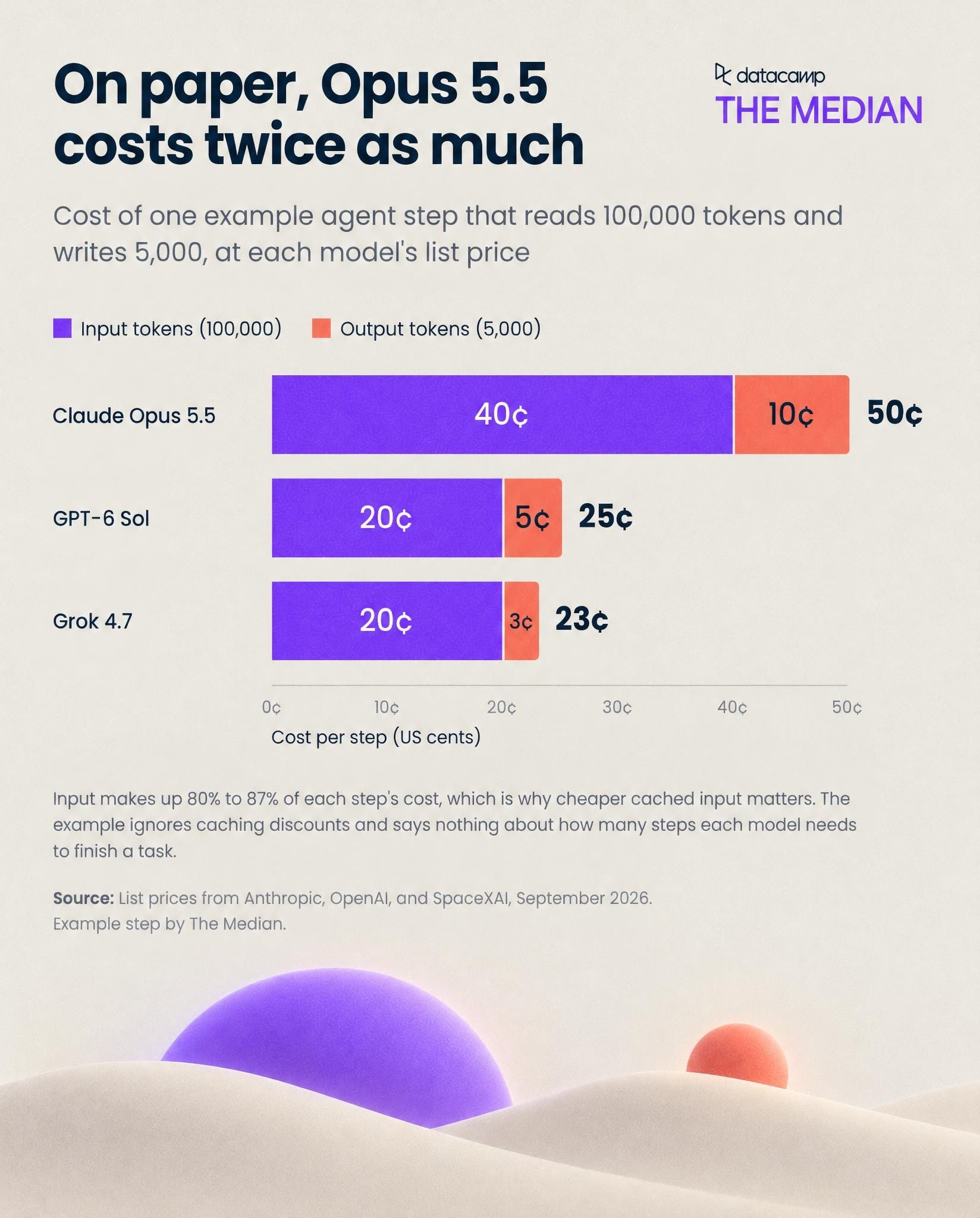
By this measure, Opus 5.5 costs about twice as much as its two rivals. The measure leaves out one thing: how many steps, and how many tokens, each model needs to get a job done.
Why price per token can mislead
A bill is the price per token multiplied by the number of tokens used, and the second number varies a lot between models. Some models reason at greater length before answering, some write longer answers, and some need more attempts to finish a task.
A model that charges half as much per token but uses three times as many tokens ends up 50% more expensive.
OpenAI’s own claim shows how large that effect can be. Opus 5 charges $5 and $25 per million tokens, two and a half times Sol’s rates, so on price alone Sol would cost about 40% of what Opus 5 costs for the same task. OpenAI says it costs 9%.
Most of the gap must come from Sol using far fewer tokens than Opus 5 running at maximum effort, a setting that makes a model think longer. The comparison is OpenAI’s, on a test and settings OpenAI chose, but the arithmetic holds for any pair of models.
Anthropic makes the same point from the other side. Opus 5.5’s per-token prices are 20% lower than Opus 5’s, yet Anthropic says typical workloads cost 40% less. Two things close the gap. The model needs fewer tokens per task, and the discounted rate for cached input (text the model has already processed, such as a codebase or a long conversation that an agent rereads at every step) fell 60%, to $0.20 per million tokens.
If you need to choose between models, the most reliable way to compare cost per task is to run the same real workload on two or three models and read the bills.
The second price war, against open-weight models
Closed labs also compete with open-weight models, which anyone can download and run and which cost much less per token.
Researchers Frank Nagle and Daniel Yue found that closed models cost $1.86 per million tokens on average, compared with 23 cents for open ones, while open models reach about 90% of the performance of closed models when they are released.
Businesses have noticed. Vercel’s AI Gateway index shows that in August open-weight models handled 56% of the tokens that passed through its service, up from 7% in December 2025, for the first time a majority. Companies are sending large volumes of routine work to cheap open models and still paying closed labs for the harder part.
A study of OpenRouter traffic found the same direction of travel, with open models reaching about a third of usage by late 2025 and Chinese open models close to 30% in some weeks. As we noted in the brief above, The New York Times reported a similar rise in open-weight spending on OpenRouter this year.
Why closed labs can still compete on total cost
This week’s prices suggest the closed labs have more room in that second contest than the per-token gap implies, for two reasons.
First, open weights are free to download, but running them isn’t. A company that hosts a large open model needs GPUs. On Google Cloud, a server with eight NVIDIA H100 chips costs $88.49 an hour on demand in its main US region, before the engineers who keep it running.
Paying a hosting provider per token avoids that, but the provider charges for the same hardware. Nagle and Yue list infrastructure and switching costs among the reasons companies stay with closed models.
Second, the multiplication from the previous sections works against cheap models too. In a 2025 study by Nous Research, open-weight reasoning models used about four times as many tokens as closed models on knowledge questions and two to three times as many on math problems.
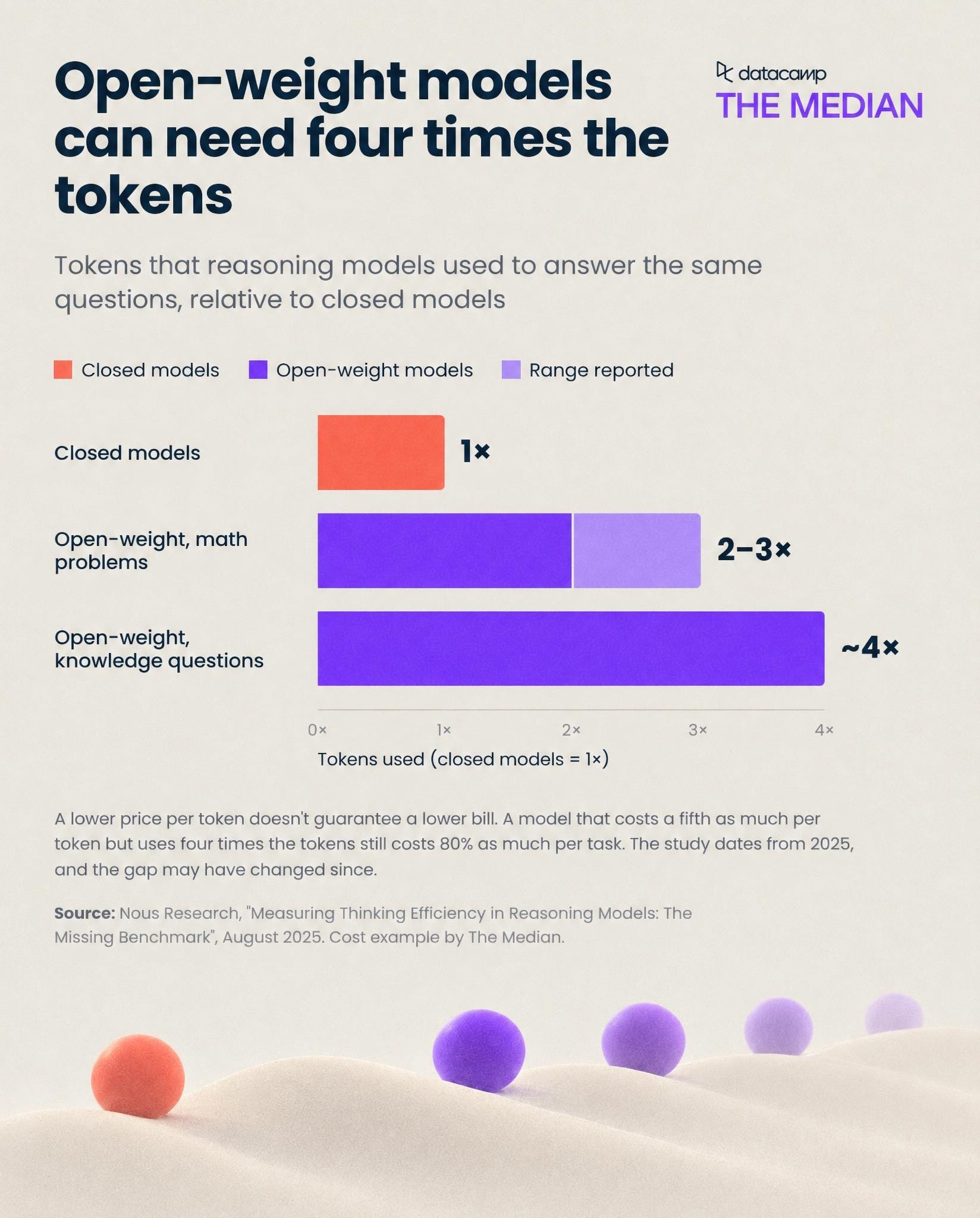
The study is a year old, and the gap may have changed, but the mechanism hasn’t. A model that costs a fifth as much per token and needs four times the tokens saves only a fifth of the bill.
Last week, we looked at who stands to gain from Dario Amodei’s proposal to slow the frontier. The rules would mostly formalize safety work Anthropic and OpenAI already pay for while adding costs for other labs.
This week’s releases suggest that closed AI labs may be able to defend their business on cost per task without help from regulation. If that is true, it weakens the competitive argument for pacing rules and leaves safety as the case those rules have to stand on.
Industry Use Cases
WEF Report Helps Companies Decide Whether to Build or Buy Supply Chain AI
The World Economic Forum and Accenture analyzed more than 600 AI start-ups working on supply chain resilience and interviewed more than 50 industry leaders, investors, and academics. The report sets out a framework for deciding when a company should build an AI tool itself, buy one, or partner with a start-up, and it notes that many of these tools are designed to work alongside existing enterprise systems. Read more in this report from the World Economic Forum.
MIT Uses AI to Steer an Insect-Sized Flying Robot for Search and Rescue
MIT researchers gave a flying robot lighter than a paperclip a controller that pairs model-predictive control with a deep-learning policy trained by imitation. The robot flew 450% faster than earlier versions and completed 10 somersaults in 11 seconds, and the team hopes it could one day search earthquake rubble. For now, it still relies on an external motion-capture system to track its position. Read more in this article from ScienceDaily.
AlphaFold Database Adds Predicted Structures for More than 2,800 Viruses
A group including Google DeepMind, EMBL’s European Bioinformatics Institute, and NVIDIA added predicted 3D structures of protein complexes from more than 2,800 viruses to the open AlphaFold Database. About 30% of the protein interactions in the release are new to science, which gives researchers working on vaccines and antiviral drugs structural data they previously lacked. NVIDIA also open-sourced the GPU pipeline it used to generate the structures. Read more in this article from NVIDIA.
Tokens of Wisdom
If you don’t know how to solve a problem yourself, there’s no way to judge whether a human or a machine has solved it correctly.
—Ledion Bitincka, CTO at Cribl
This week on the DataFramed podcast, we talked with Ledion Bitincka (CTO at Cribl) and Nikhil Mungel (Head of AI R&D at Cribl). We discussed software telemetry fundamentals, AI-powered software factories, measuring product value through growth metrics, the shift from knowledge work to judgment work, and more.